TL;DR: New Mexico is a pure comparative negligence state under NMSA 41-3A-1 — even if you are 90% at fault for your own slip and fall, you can still recover 10% of damages from the property owner. The statute of limitations is 3 years (NMSA 37-1-8) for private property, but only 2 years with a 90-day written notice if the defendant is a government body. Liability depends on where you fell and whether the owner inspected, knew about, or should have known about the hazard. Below: the four most common New Mexico slip-and-fall scenarios and who is actually on the hook.
The legal framework, in 60 seconds
New Mexico premises liability used to follow the old "invitee / licensee / trespasser" framework — different duties for each category. The Supreme Court of New Mexico has substantially flattened that distinction in modern cases: as long as you are lawfully on the property, the owner owes you a duty of reasonable care to keep the premises safe and to warn of known hazards.
To win a slip-and-fall case in New Mexico, you generally need to prove:
- A dangerous condition existed on the property.
- The owner created the condition, knew about it, or should have known about it (constructive notice).
- The owner failed to fix it or warn you about it within a reasonable time.
- That failure caused your injuries and quantifiable damages.
Pure comparative negligence means even partial fault by you doesn’t kill the case — it just reduces the recovery proportionally. A jury finding that you were 30% responsible (texting while walking, ignoring a wet-floor sign) reduces a $100,000 award to $70,000. New Mexico is one of about 13 states that follows this pure model.
Scenario 1: Slip on a wet floor at an Albuquerque grocery store
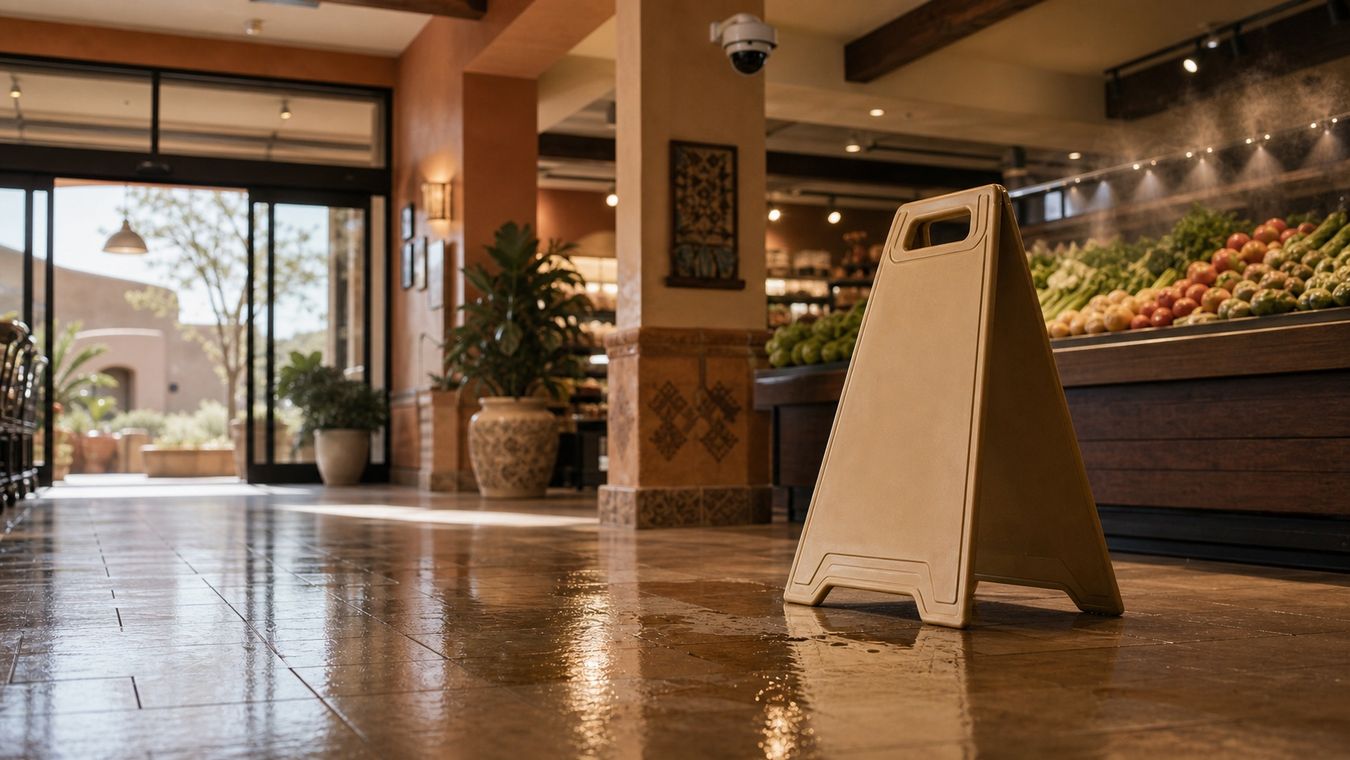
This is the textbook slip-and-fall. You walk into a Smith’s, Whole Foods, Albertsons, or Walmart in Albuquerque. There is water near the produce misters, ice melt by the entrance, or a spilled bottle of cooking oil three aisles over. You go down. Hard.
Liability questions a New Mexico premises lawyer will ask:
- How long had the hazard been there? Grocery stores have inspection schedules — typically every 15 to 30 minutes. If the chain’s own policy required an inspection in the last 20 minutes and there is no documentation it happened, you have constructive notice.
- Did the store create the hazard? Auto-misters that spray produce, leaking refrigerator cases, freshly mopped floors without barricades — all are "created by the store" and require zero proof of notice.
- Were warning signs deployed? A "wet floor" cone in the right place can defeat the case. Absence of cones near a known hazard supports liability.
- Surveillance video? Albuquerque grocery chains retain video for 7–30 days. Send a preservation letter the same week or it’s gone forever.
Scenario 2: Trip on a broken sidewalk in Santa Fe
Santa Fe’s historic walkways are charming and dangerous. Cracked flagstones, uneven pavers, and tree-root buckling produce trip-and-fall cases every tourist season. The legal complexity here is figuring out who owns the sidewalk.
- In the public right-of-way: The City of Santa Fe is the defendant. That triggers the New Mexico Tort Claims Act — you must give written notice to the public body within 90 days and file suit within 2 years (not the usual 3).
- On private property the city has assumed maintenance of: Often both the city and the adjacent property owner are co-defendants. Several liability under NMSA 41-3A-1 means each pays only their fault share.
- In a historic district with an HOA or merchants’ association: Maintenance agreements between the city and the association often shift liability — and those agreements are public records worth pulling early.
The 90-day notice rule under the Tort Claims Act is the single most common case-killer in New Mexico government slip-and-fall claims. Don’t wait to find out which entity owned the walkway — file notice with every plausibly responsible body in the first 60 days.
Scenario 3: Fall at a Las Cruces or Roswell hotel
Hotel slip-and-fall cases in New Mexico tourist corridors (Las Cruces, Roswell, Taos, Ruidoso) have their own pattern. The most common fact sets:
- Pool deck slip — wet tile, missing non-slip strips, broken rails.
- Bathtub or shower fall — missing grab bars in a "renovated" room, soap residue from prior guest, inadequate non-slip mat.
- Lobby slip on tracked-in moisture — particularly common after monsoon rains in southern New Mexico.
- Stair fall — loose carpet, missing tread strips, inadequate lighting.
Hotels in New Mexico owe guests an elevated duty as paying invitees. The legal exposure is broader than for casual visitors. Damages tend to be higher because hotel falls disproportionately injure older travelers, and because the chain’s deeper pockets support more thorough investigation.
A specific note on Airbnb / short-term rentals: the platform itself is generally not liable for host negligence under § 230-style protections, but the individual host’s homeowners or commercial liability insurance frequently covers slip-and-fall claims up to policy limits. New Mexico has not yet enacted a specific short-term rental liability statute, so common-law premises rules apply.
Scenario 4: Slip in a government building (courthouse, DMV, VA hospital)
Falls in New Mexico government buildings — Bernalillo County courthouses, Albuquerque or Santa Fe DMV offices, federal buildings, VA medical centers — have the harshest procedural rules and the most case-killing notice deadlines.
- State-owned facilities: New Mexico Tort Claims Act — 90-day written notice; 2-year limitations.
- County or city facilities: Same 90-day notice via the Tort Claims Act.
- Federal facilities (VA, post offices, federal courthouses): Federal Tort Claims Act — 2-year administrative claim deadline (Standard Form 95), then 6-month wait, then 6 months to file suit if the agency denies the claim.
The notice paperwork for each layer is different. The lawyer you hire needs to know which government Russian-doll you fell inside. A misfiled notice goes nowhere.
What every New Mexico slip-and-fall victim should do in the first 14 days
- Document the scene immediately. Photos of the hazard, of warning signs (or absence of them), of the surrounding area. If there were witnesses, get names and numbers before they walk away. Lighting matters — bring a friend with a phone flashlight if the fall was indoors.
- Report the incident to management. Ask for a written incident report. Take a photo of it before leaving. Many chains will refuse to give you a copy at the scene; you can request it later.
- Get medical care the same day. Even if it feels minor. Soft-tissue injuries and concussions worsen for days. The medical record from day one is the most valuable piece of evidence in your case.
- Send a preservation letter to the property owner. Demands they preserve surveillance video, incident reports, and inspection logs. Without this letter, video routinely gets overwritten within 30 days.
- If a government body is even plausibly involved, file Tort Claims notice within 30–60 days. Don’t wait for the 90-day deadline. Don’t wait to "figure out exactly who owns the sidewalk." File on every plausible defendant.
- Talk to a New Mexico slip-and-fall lawyer before talking to the property owner’s insurer. Recorded statements to adjusters are weaponized against you later.
FAQ
Does it matter if I was wearing flip-flops or distracted on my phone?
Under NMSA 41-3A-1 pure comparative negligence, your conduct reduces your recovery but does not eliminate it. A jury may decide you bear 20–40% of the fault for inappropriate footwear or inattention. Your recovery drops by that percentage. The case is still worth bringing in most circumstances.
How much is a typical New Mexico slip-and-fall case worth?
Anchoring is hard — case value tracks injury severity. Minor sprain cases settle for $5,000–$20,000. Cases involving a broken hip, traumatic brain injury, or surgery commonly exceed $250,000. Severe permanent-disability cases involving fall-related quadriplegia or wrongful death routinely settle in the seven figures. A real range depends on the specific medical record.
What if I fell at work in New Mexico?
Workplace falls go through New Mexico workers’ compensation, not premises liability. Workers’ comp pays medical bills and lost wages without proving negligence, but it caps recovery. Some cases — falls caused by a third party’s negligence on the premises (e.g., a subcontractor, a delivery driver) — support both a workers’ comp claim and a third-party premises claim. A New Mexico injury lawyer can evaluate both tracks.
Will my case go to trial?
Most New Mexico slip-and-fall cases settle. Roughly 90–95% never see a jury. Settlement value goes up if the lawyer credibly threatens trial and has the file built to support it.
Can I sue if I tripped over a hazard I had seen before?
Yes, but harder. "Open and obvious" hazards reduce the property owner’s duty to warn. Pure comparative negligence still applies, but a jury may put more fault on you. Some New Mexico courts have rejected the "open and obvious" doctrine in cases where the plaintiff was distracted by a foreseeable circumstance (carrying packages, looking at signage, herding children).
The clock starts the day you fall
Three years sounds like a long time. It isn’t — not by the time you’ve sorted out who owns which sidewalk, identified the right insurance carrier, and gotten a full picture of your injury arc. Government cases compress that even harder: 90 days for the notice, 2 years for the lawsuit.
Find a New Mexico premises liability lawyer before the surveillance video is gone. Get matched with attorneys in Albuquerque, Santa Fe, Las Cruces, or anywhere else in New Mexico in under a minute.
DearLegal is not a law firm and does not provide legal advice. This article is for informational purposes only. Consult a licensed attorney in your state for advice on your specific situation.